The Jean Valjean Problem
Introduction
The "Jean Valjean problem" is a foundational ethical and legal dilemma asking whether it is morally permissible to steal—in this case, food—to save a life. Derived from Victor Hugo's Les Misérables, it questions whether fundamental human needs and the right to survival override property rights, strict legal codes, and societal ramifications.
The Problem
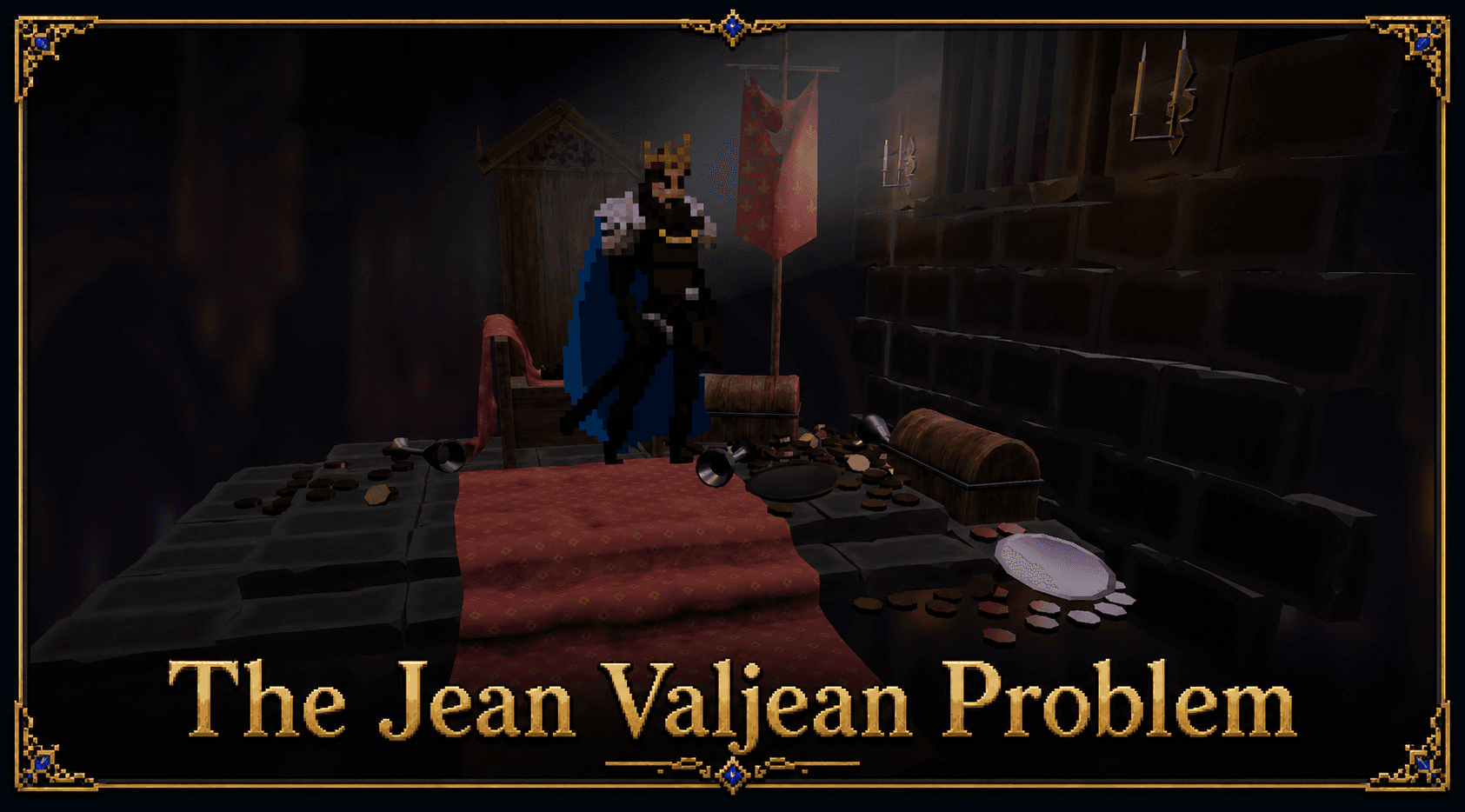
A peasant was caught stealing bread from a local merchant. The peasant pleads for mercy, claiming that his children are starving, and his wife ill. You are Duchess Alice, and will defend compassion. The merchant insists that theft, however small, harms others: the loaf could have fed another poor family who paid. He calls for justice, not sympathy. Your opponent, Count Robert, upholds order. Use logic, cunning, and even deceit to sway the King's decision. Directly address the King, dabble in Gossip or Politics, and speak to the court Oracle to meddle with the cosmos... if you dare.
The Judge
Every match gives the king a private personality made from two compatible values and two formative experiences. You are not shown the profile directly; you have to infer it from what he notices, rewards, doubts, or dismisses.
| Value | Formative experience |
|---|---|
| Self-direction | As a young prince, he defied his council and opened the winter roads early; the gamble saved three isolated villages and taught him to trust independent judgment. |
| When guild law barred a gifted commoner from the royal academy, he waived the rule and later watched her become his finest engineer. | |
| He once obeyed unanimous advice he believed mistaken, and the resulting crop failure left him ashamed of surrendering his own judgment. | |
| Stimulation | During a border crisis, an untested cavalry maneuver broke a siege that conventional tactics had prolonged for months. |
| He funded an eccentric inventor whose floodgates succeeded after every established engineer dismissed the design. | |
| A season of rigid court routine once allowed a smuggling network to flourish unnoticed, leaving him suspicious of familiar solutions. | |
| Hedonism | After surviving a fever that nearly killed him, he reopened the kingdom's festivals and came to regard joy as a public good rather than a luxury. |
| He watched years of austerity make the capital obedient but joyless, and swore that a realm should offer its people more than bare survival. | |
| A beloved sister spent her short life fulfilling duties she hated, leaving him wary of virtues that demand happiness always be postponed. | |
| Achievement | His father dismissed him as an ornamental prince until he personally reorganized the failing royal mint and restored its solvency. |
| He promoted a miller's daughter after her irrigation plan doubled the eastern harvest, confirming his belief that results should outrank pedigree. | |
| A celebrated general once blamed every defeat on circumstance; the king removed him and has distrusted excuses unsupported by performance ever since. | |
| Power | Early in his reign, rival nobles exploited a hesitant decree and nearly divided the kingdom, teaching him that uncertain authority invites predation. |
| He ended a barons' revolt with one public dismissal and no bloodshed, and remembers that control can prevent greater violence. | |
| A neighboring monarch treated his generosity as weakness and seized a disputed valley, leaving him determined never again to make the crown look pliable. | |
| Security | He was a child when riots emptied the capital's markets for nine days, and he still remembers respectable families fighting over sacks of grain. |
| A carefully maintained chain of granaries carried the kingdom through two failed harvests, cementing his faith in stable institutions. | |
| One lightly guarded mountain pass once admitted raiders who destroyed an entire township, making small neglected risks difficult for him to dismiss. | |
| Conformity | He once pardoned a popular captain for ignoring orders; within a month, three lesser officers claimed the same privilege and soldiers died in the confusion. |
| A tax exemption granted to one grieving household produced a flood of invented petitions, convincing him that exceptions readily become permissions. | |
| As prince, he accepted punishment for breaking curfew alongside common cadets and came to see equal submission to rules as a form of dignity. | |
| Tradition | During a succession crisis, the old coronation compact gave rival houses a procedure they all accepted and prevented civil war. |
| He abolished an obsolete harvest rite only to see rural trust in the crown collapse, teaching him that customs can carry obligations invisible to reformers. | |
| His grandmother governed through famine by invoking duties older than any living noble, and her example made inherited institutions feel like accumulated memory. | |
| Benevolence | When plague reached the palace quarter, a kitchen servant hid his illness to keep feeding the royal children and died before the king learned his name. |
| He once visited a soldier's widow whom the treasury had forgotten, and her quiet poverty made neglect by distant officials feel like his personal failure. | |
| A village sheltered him during a youthful hunting accident without knowing his identity, leaving him fiercely protective of ordinary people who depend on the crown. | |
| Universalism | He watched a foreign laborer receive a harsher sentence than a noble for the same offense and overturned both judgments in disgust. |
| A drought taught him that upstream privilege could starve families who had no voice at court, so he imposed one water law on every estate. | |
| Peace came to a divided province only after its rival faiths received equal protection, convincing him that justice must reach beyond kin and faction. |
Gossip
Gossip contains personal relationships, secrets, rumors, and details close to the people in the room. Five cards are dealt each match, and the deck is sealed after one is played.
| Card | Text |
|---|---|
| The Magician | The King’s own mother was once a starving peasant who stole to survive. |
| The Popess | The Queen secretly donates to orphanages but hides it from the treasury. |
| The Queen | The peasant’s son once saved the life of the royal falcon. |
| The King | The King has recurring dreams of famine and guilt. |
| The Pope | A courtier has been spreading rumors that the King has grown cold-hearted. |
| The Lovers | The royal baker was once a thief himself before being pardoned and hired. |
| The Chariot | The King’s favorite knight grew up poor and often stole food as a child. |
| Justice | The King’s younger brother secretly fathered a child with a peasant woman. |
| The Hermit | The royal jester is known to give food to beggars against orders. |
| The Wheel of Fortune | The King recently lost his appetite after the death of his beloved hound. |
| Strength | The Princess has been sneaking food to the slums, wearing a hood. |
| The Hanged Man | The peasant’s wife once nursed a wounded royal guard back to health. |
| Death | The High Priest warned of a coming curse if mercy is not shown to the lowborn. |
| Temperance | The King fears rebellion after recent peasant unrest in the northern provinces. |
| The Devil | The Grand Vizier secretly grew up in the same village as the peasant. |
| The House of God | A noble’s spoiled son was caught stealing wine but faced no punishment. |
| The Star | The Queen miscarried during a famine, and the memory still haunts her. |
| The Moon | The peasant was once mistaken for a noble’s bastard and beaten for it. |
| The Sun | The King’s old tutor wrote a book arguing against punishing hunger with prison. |
| Judgment | A prophecy foretold a ruler’s fall over a single loaf of bread. |
| The World | The royal cat ran away last week and has been spotted near the peasant’s house. |
| The Fool | The King’s cousin was caught gambling with treasury funds and went unpunished. |
| Ace of Wands | The peasant bears the same birthmark as the King’s long-lost twin. |
| Two of Wands | The castle cook complains daily about wasted food in the palace. |
| Three of Wands | The King once disguised himself and shared a meal with peasants. |
| Four of Wands | The peasant’s daughter is a gifted singer who once moved the court to tears. |
| Five of Wands | The King’s father executed a hungry thief, and it sparked a decade of rebellion. |
| Six of Wands | The court astrologer warned that justice misaligned with compassion will bring ruin. |
| Seven of Wands | The King’s heart aches from a recent betrayal and seeks redemption. |
| Eigh of Wands | The royal physician is secretly treating the peasant’s sick wife. |
| Nine of Wands | A maid overheard the Queen say, “Sometimes it’s the hungry who are most honest.” |
| Ten of Wands | The King's illegitimate child lives among the poor and may face the same fate. |
| Page of Wands | The royal stable boy says the horses are better fed than the children in town. |
| Knight of Wands | The royal hound growled at a visiting duke but licked the peasant’s hand. |
| Queen of Wands | The King’s late brother once spared a thief, and it saved his life in war. |
| King of Wands | The peasant crafted the King’s coronation boots, worn that very day. |
| Ace of Cups | The court artist is painting a mural of mercy for the throne room. |
| Two of Cups | The peasant is suspected of being a seer who once predicted the Queen’s recovery. |
| Three of Cups | The King is haunted by a lullaby his nurse used to sing—about hunger and hope. |
| Four of Cups | The royal ledger shows food prices rose unfairly after a noble’s monopoly. |
| Five of Cups | The Captain of the Guard expressed doubts about jailing a starving man. |
| Six of Cups | A foreign ambassador in court was once caught stealing in his youth. |
| Seven of Cups | The King secretly visits a peasant woman for counsel when troubled. |
| Eight of Cups | The Prince recently gave a public speech about fairness and equality. |
| Nine of Cups | The King’s dog brought the peasant a loaf just the night before. |
| Ten of Cups | A scandal is brewing over missing grain shipments from the palace stores. |
| Page of Cups | The King’s grandmother used to say, “Hunger makes thieves, but mercy makes kings.” |
| Knight of Cups | The court cook is the peasant’s estranged brother, who disowned him years ago. |
| Queen of Cups | The bard is composing a ballad about the stolen bread, and it’s gone viral in taverns. |
| King of Cups | The peasant shares a name with the King’s childhood best friend. |
| Ace of Pentacles | The King’s favorite painting depicts a starving family in winter. |
| Two of Pentacles | The noblewoman leading the charge for punishment has been skimming from tithes. |
| Three of Pentacles | The Princess argues fiercely with her tutor over the ethics of punishment. |
| Four of Pentacles | The peasant built the bench in the King’s favorite garden alcove. |
| Five of Pentacles | The King’s late wife always fed the poor in secret; it was her dying wish. |
| Six of Pentacles | A palace ghost is said to haunt anyone who punishes the innocent. |
| Seven of Pentacles | A spy claims the peasant has been organizing dissent in the bread lines. |
| Eight of Pentacles | The King’s own journals, if discovered, would show sympathy toward thievery. |
| Nine of Pentacles | The court seamstress was once caught stealing thread but was spared and now thrives. |
| Ten of Pentacles | The steward recently diverted funds from the food budget to build a fountain. |
| Page of Pentacles | A mural in the throne room depicts justice blindfolded—cracked recently by accident. |
| Knight of Pentacles | A mysterious donor recently paid the peasant’s debts at the city granary. |
| Queen of Pentacles | The Queen’s necklace was stolen last week, and paranoia is high. |
| King of Pentacles | The peasant’s child has a rare illness only treatable with nutrition. |
| Ace of Swords | A rumor suggests the peasant might be a war hero in hiding. |
| Two of Swords | A bard claims to have heard the bread cry out “Let me feed the hungry!” |
| Three of Swords | The royal family dines on golden plates while famine spreads outside the gates. |
| Four of Swords | The peasant once saved a knight during a bandit ambush in the outer provinces. |
| Five of Swords | The King has been secretly fasting to understand the pain of the poor. |
| Six of Swords | A former lover of the King now lives among the peasantry. |
| Seven of Swords | The palace garden is overflowing with unused fruit left to rot. |
| Eight of Swords | The King’s dream interpreter says he must "forgive the humble hand" to avoid doom. |
| Nine of Swords | A nobleman recently evicted dozens of families for unpaid taxes. |
| Ten of Swords | The castle’s youngest page was orphaned after a famine; the King knows his story. |
| Page of Swords | The Queen was overheard saying, “We build prisons when we should build granaries.” |
| Knight of Swords | A foreign queen visiting the court is known for her brutal punishments and is watching. |
| Queen of Swords | The peasant quoted scripture during arrest: “Man does not live by bread alone.” |
| King of Swords | The King secretly writes poetry about kindness and disguise. |
Politics
Politics contains laws, markets, religion, unrest, and other consequences for the kingdom as a whole. Five cards are dealt each match, and the deck is sealed after one is played.
| Card | Text |
|---|---|
| Augur of Moons | A prolonged drought has led to widespread crop failures and food scarcity. |
| Augur of Suns | The kingdom is currently at war with a neighboring empire. |
| Augur of Snakes | A famine has recently devastated the outer provinces. |
| Augur of Vice | Peace talks are underway with a rival kingdom known for its strict justice system. |
| Augur of Stars | The royal treasury is nearly depleted due to overspending on a failed magical expedition. |
| Augur of Flowers | A rebellion is brewing in the eastern provinces led by a populist warlord. |
| Augur of Runes | A holy order has declared stealing to be a mortal sin and demands strict punishment. |
| Augur of Authority | The kingdom's prisons are overfilled, straining resources. |
| Augur of Victory | A recent prophecy warned of unrest if the people are treated unjustly. |
| Augur of Virtue | The harvest festival is approaching, and public sentiment is sensitive. |
| Augur of Blaze | A powerful noble was recently caught in a scandal involving corruption and theft. |
| Augur of Humility | A merchant guild is lobbying for harsher laws to protect their goods. |
| Augur of Cages | The royal heir has been secretly helping the poor and has gained popularity. |
| Augur of Guests | Bandits have been increasingly bold, citing desperation as justification. |
| Augur of Hemlock | A foreign delegation is visiting, observing the kingdom’s governance. |
| Augur of Beetles | A dragon has demanded tribute, draining the kingdom’s food supplies. |
| Bode of Moons | A secret society within the palace believes the king should rule with an iron fist. |
| Bode of Beards | The kingdom was founded on principles of compassion and justice. |
| Bode of Lanterns | The Queen is championing a new initiative for restorative justice. |
| Bode of Five | A golem army patrols the streets and executes laws without nuance. |
| Bode of Time | The city’s food stores are under lock and key due to recent riots. |
| Bode of Oriel | A magical artifact has gone missing from the royal vault. |
| Bode of Fins | The courts are corrupt and feared more than respected. |
| Bode of Three | A rival noble family is questioning the king’s competence and softness. |
| Bode of Thunder | The king recently enacted a law to pardon first-time offenders. |
| Bode of Moths | A plague has reduced the population of able-bodied workers. |
| Bode of Wisdom | Trade caravans from the south have been raided, causing economic strain. |
| Bode of Light | A divine figure has been appearing in dreams to the peasantry, preaching mercy. |
| Bode of Mist | A peasant uprising occurred last winter and was violently suppressed. |
| Bode of Mystery | Taxes were recently raised, and the peasantry is near revolt. |
| Bode of Mines | The kingdom has just signed a non-aggression pact with an elven confederacy. |
| Bode of Keys | An enchanted forest nearby has become impassable, disrupting trade routes. |
| Commination of Mirrors | The peasant was once a decorated soldier in the king’s army. |
| Commination of Stars | The people suspect the guards of hoarding food for themselves. |
| Commination of Wisdom | The royal chef was recently assassinated, and paranoia is high. |
| Commination of Stags | The kingdom is undergoing a religious reformation with opposing doctrines. |
| Commination of Mushrooms | A new magical university is training future leaders in ethics and governance. |
| Commination of Zealots | The king’s father was known for mercy and is still widely beloved. |
| Commination of Stairs | A powerful oracle’s latest vision depicted a starving child becoming a future hero. |
| Commination of Wine | Troll raiders have disrupted border villages, and security is tight. |
| Commination of Moths | A local wizard’s curse has caused livestock to die mysteriously. |
| Commination of Tides | The stars are aligned in a rare celestial pattern interpreted as omens of change. |
| Commination of Vengeance | The capital recently hosted a public execution that stirred controversy. |
| Commination of Hearts | A magical illness affecting only nobles has created class tension. |
| Commination of Beetles | Elven emissaries have offered aid only if human rights are respected. |
| Commination of Victory | A recent census revealed shocking levels of poverty and inequality. |
| Commination of Moutains | A comet just passed through the sky, interpreted by many as a call for renewal. |
| Commination of Wheat | The king’s personal mentor was born a peasant and preaches understanding. |
| Dream of Scales | The kingdom’s primary grain supplier has been wiped out by locusts. |
| Dream of Health | The peasant’s child is rumored to possess latent magical abilities. |
| Dream of Stars | The city walls were breached last year, and law enforcement was overwhelmed. |
| Dream of Wisdom | A cult has formed in the slums, glorifying lawlessness as divine will. |
| Dream of Suns | A neighboring kingdom just abolished all prisons, to global applause. |
| Dream of Ten | The Church of the Silver Flame insists on public penance over imprisonment. |
| Dream of Owls | An ancient pact demands blood restitution for all crimes of theft. |
| Dream of Keys | The kingdom’s scribe guild is lobbying for a written code of ethics. |
| Dream of Oriel | The local populace reveres a legend of a kind king who fed the poor during famine. |
| Dream of Doves | The new Prime Magistrate is known for harsh and unflinching policies. |
| Dream of Mystery | A massive feast is being planned at court while citizens starve. |
| Dream of Snakes | The king’s recent illness has left him more empathetic to common suffering. |
| Dream of Stars | A new tax collector is exploiting the poor under the king’s banner. |
| Dream of Moutains | The local oracle claims the peasant is part of a grander destiny. |
| Dream of Wheat | The kingdom is being considered for admission into a magical federation. |
| Dream of Globes | A former king once forgave a similar act, and the story is told in schools. |
| Exile of Swords | Dwarves in the north are threatening to withhold vital ore unless justice is fair. |
| Exile of Wisdom | The city guard has recently been accused of brutality and extortion. |
| Exile of Blaze | A royal decree forbids theft but includes no exceptions for survival. |
| Exile of Moons | Criminal gangs are using fake sob stories to evade justice. |
| Exile of Victory | A mysterious traveler claims to be testing the kingdom’s morality. |
| Exile of Bows | The bread was taken from a temple bakery that serves the rich. |
| Exile of Five | A bard’s song about injustice has gone viral across the kingdom. |
| Exile of Cloaks | A sentient relic in the castle whispers conflicting advice to the king. |
| Exile of Globes | The High Sorcerer warns that leniency could unravel magical order. |
| Exile of Beetles | Demons whisper promises to those suffering from hunger. |
| Exile of Castles | The king’s cousin was once kidnapped by thieves and never recovered. |
| Exile of Wheat | The peasants recently saved the city from a flood, earning praise. |
| Exile of Mountains | A shadow court within the palace manipulates legal decisions. |
| Exile of Health | A werewolf incident last moon strained law enforcement resources. |
| Exile of Death | The king’s spies suggest that unrest will escalate either way. |
| Exile of Doves | A ghost haunts the dungeon, only visible to those unjustly imprisoned. |
Tips and Tricks
There is no morally correct side to memorize. Alice should turn need into a concrete case for mercy; Robert should explain why one sympathetic exception could damage law, trust, or the merchant who was robbed. Pay attention to the king's reactions for clues about his private values, then choose cards and arguments that speak to those priorities. If your opponent makes a weak argument, attack it decisively.
The game rewards the player who most effectively moved this particular judge, so make a ruling feel workable—not necessarily "correct."